22 Sep 2026
The automobile and auto-component industry depends on consistent product quality, controlled manufacturing processes, traceability, reliable suppliers and customer-specific requirements. A small variation in an automotive component can affect assembly, vehicle performance, safety and customer satisfaction.
For this reason, automobile parts manufacturers need systematic quality and process controls rather than relying only on final product inspection.
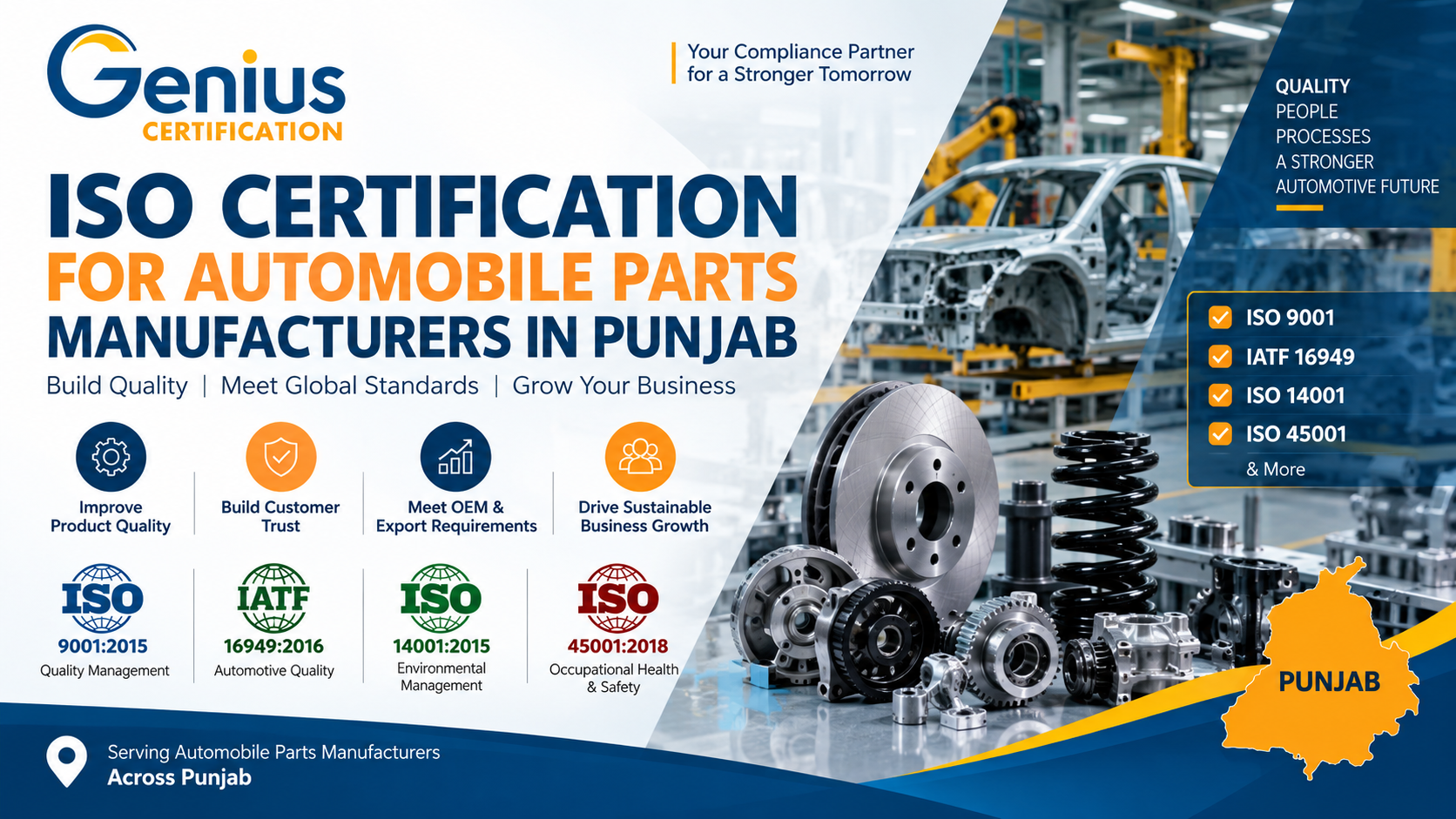
ISO Certification for Automobile Parts Manufacturers in Punjab provides a structured framework for establishing, maintaining and improving management systems that support consistent operations and customer requirements.
Depending on the nature of the business, its products and customer expectations, an automotive manufacturer may consider ISO 9001, IATF 16949, ISO 14001 and ISO 45001.
For businesses supplying automobile components to OEMs, Tier 1 suppliers, Tier 2 suppliers, distributors or export markets, selecting the correct certification is particularly important.
ISO certification is an independent assessment of an organization's management system against the requirements of a specific standard.
For an automobile parts manufacturer, certification can cover activities such as:
The certification scope should accurately represent the organization's actual activities and locations.
A certificate should therefore not be selected simply because it is commonly advertised. The applicable standard should be determined from the company's products, processes, customers, contractual requirements and intended markets.
Different management-system standards address different business requirements.
ISO 9001 is a Quality Management System standard that can be applied to organizations across different industries.
For automotive component manufacturers, ISO 9001 can help establish controls for:
It can be particularly relevant for manufacturers that need a structured quality-management system but do not have an automotive-specific customer requirement for IATF 16949.
IATF 16949 is an automotive quality management standard developed for organizations within the automotive supply chain.
It builds on the principles of ISO 9001 while incorporating additional automotive-specific requirements.
It is particularly relevant when an automotive manufacturer or supplier needs to demonstrate compliance with automotive quality-management expectations.
Depending on the organization and customer requirements, automotive quality practices can involve areas such as:
Manufacturing activities may involve waste, energy consumption, chemicals, emissions and other environmental aspects.
ISO 14001 provides an Environmental Management System framework for identifying and managing environmental responsibilities.
Automotive manufacturing can involve machinery, production equipment, material handling, chemicals and other workplace hazards.
ISO 45001 provides a framework for managing occupational health and safety risks.
One of the most important questions for automotive businesses is whether they need ISO 9001 or IATF 16949.
| Factor | ISO 9001 | IATF 16949 |
|---|---|---|
| Main focus | Quality Management System | Automotive Quality Management System |
| Industry | Cross-industry | Automotive supply chain |
| Automotive-specific requirements | Limited | Yes |
| Customer-specific requirements | Managed according to applicable requirements | Strong automotive focus |
| Suitable for automotive suppliers | Depending on customer requirements | Specifically designed for automotive supply chain |
| Quality improvement | Yes | Yes, with automotive-specific controls |
The correct choice depends on the organization's business model and customer requirements.
An automotive component manufacturer should check whether its OEM, Tier 1 customer or contractual arrangement specifies a particular certification.
Automotive customers generally expect suppliers to demonstrate controlled and repeatable processes.
For an automobile parts manufacturer, a structured management system can help improve:
Defined processes make it easier to control production activities and maintain consistent output.
Quality controls can help identify defects, nonconformities and process weaknesses.
Manufacturers often depend on raw-material and component suppliers. A structured supplier evaluation process can help manage incoming quality and supply risks.
Depending on the product and customer requirements, traceability controls can help identify materials, batches, production records and inspection information.
Certification can provide documented evidence that the organization operates a recognized management system.
Internal audits, corrective actions, performance monitoring and management reviews can support systematic improvement.
Requirements vary according to the selected standard and certification scope.
However, an automobile parts manufacturer should generally have effective controls around:
For automotive suppliers, additional customer-specific requirements may also need to be considered.
An effective management system should reflect the organization's actual manufacturing processes.
Depending on the company, these may include:
Each process can have different quality risks and control requirements.
This is why a process-based approach is more useful than using generic certification documentation that does not match the actual factory operations.
The certification journey generally follows a structured approach.
The first step is determining whether ISO 9001, IATF 16949, ISO 14001, ISO 45001 or another applicable certification matches the company's requirements.
The scope should identify relevant products, manufacturing activities, locations and processes.
Existing practices are compared with the requirements of the applicable standard.
This identifies areas requiring improvement before certification assessment.
Policies, procedures, process controls and records are established according to the organization's actual activities.
Employees should understand the relevant processes, responsibilities and quality requirements associated with their work.
The organization evaluates whether its management system is implemented and functioning effectively.
Management reviews system performance, objectives, risks, audit results, customer feedback and improvement opportunities.
The certification body conducts the applicable assessment against the selected standard.
If nonconformities are identified, the organization addresses them through appropriate corrective action.
After successful completion of the applicable certification process, the certification body can issue certification according to the approved scope.
The exact documentation depends on the standard and organization.
Common information may include:
For automotive manufacturers, documentation should be connected to actual production and quality activities.
There is no single fixed ISO certification cost for every automobile parts manufacturer.
The final cost can depend on:
For example, the requirements of a small single-location manufacturer may differ significantly from those of a large multi-location automotive supplier.
Businesses should therefore request a scope-based quotation rather than relying on a generic advertised price.
The timeline depends on the organization's size, readiness, selected standard and certification scope.
A company with established processes and records may require less preparation than a manufacturer starting its management system from the beginning.
The preparation process can involve:
A realistic timeline should be determined after understanding the company's actual operations.
Yes. MSME automobile parts manufacturers can pursue applicable ISO certification when they meet the requirements of the selected management system and complete the relevant certification process.
Being an MSME does not mean that the organization should use a weaker quality system.
In fact, a structured management system can help smaller manufacturers organize:
The certification scope should simply reflect the actual size and activities of the organization.
ISO certification can support an organization's ability to demonstrate structured management practices to customers and business partners.
For exporters, the relevant certification can form part of a broader business-compliance framework.
However, ISO certification alone does not automatically guarantee export approval, OEM acceptance or a particular contract.
Exporters should also consider the specific regulatory, product, customer and destination-market requirements applicable to their products.
Automotive businesses should evaluate a certification service provider based on more than advertised pricing.
Consider whether the provider understands:
A professional discussion should begin with the company's products, processes, employees, locations and customers, rather than simply asking for a certificate price.
Genius Certification assists businesses seeking certification-related guidance in Punjab.
For automobile parts manufacturers, the process can be discussed around the organization's actual business scope, including:
This approach helps businesses identify a certification route that aligns more closely with their operational requirements.
The applicable certification depends on the manufacturer's products, processes and customer requirements. ISO 9001 provides a general Quality Management System framework, while IATF 16949 is specifically designed for automotive quality management.
No single certification requirement applies identically to every automotive supplier. Specific OEM, customer or contractual requirements may determine whether IATF 16949 is required.
ISO 9001 is a general Quality Management System standard applicable to many industries. IATF 16949 is designed for the automotive supply chain and includes automotive-specific requirements.
The cost depends on factors including the selected standard, number of employees, locations, certification scope, manufacturing complexity and audit requirements. A customized quotation is therefore more appropriate than a single fixed price.
The organization should identify the applicable standard, define its certification scope, assess existing processes, implement the required management system, conduct internal evaluation, address gaps and complete the certification assessment with the applicable certification body.
For automobile parts manufacturers, quality management is directly connected with customer satisfaction, process consistency and supply-chain reliability.
ISO Certification for Automobile Parts Manufacturers in Punjab can help organizations establish a structured approach to quality, process control, risk management and continual improvement.
Whether you are an automotive component manufacturer, auto parts supplier, MSME, Tier 1/Tier 2 supplier or manufacturing exporter, the appropriate certification should be selected according to your actual business activities and customer requirements.
Genius Certification can help you understand the applicable certification route and prepare for the certification process.
WhatsApp / Phone: +91-9024821055
Address: Ground Floor, Shop No. 11, EL-Commercia, PR 7 Road, Near Maya Garden City, Gate No. 3, Zirakpur, Punjab – 140603, India
Looking for ISO 9001 or IATF 16949 certification for your automobile parts manufacturing business in Punjab? Contact Genius Certification to discuss your requirements and certification scope.
ISO Stands for Genius Certification. ISO is an independent, non-governmental international organization with a membership of 162 national standard bodies.
+91-9024821055 Enquiry Now